We'd like to think we have a pretty good handle on how the world works. For help, we turn to experts who claim to understand the forces at play and the impact they will have on the economy and our lives.
But the simple fact is we don't know what's coming. And as often as not, neither do the experts.
Almost every expert said Donald Trump simply could not be president. It was impossible. In fact, those who said he could win were laughed out of the room. Lest we forget, most of these same experts also said Brexit just wasn't going to happen.
But calling an election or a referendum is one thing. All those experts with their crystal balls also got the economic impact wrong.
We were told stock markets would crash and the British economy would collapse if the U.K. voted to leave the European Union. It didn't.
They said North American markets would plummet in the wake of a Trump victory. The Dow Jones set a new all-time high the day after Trump won and has since broken its own record 11 times.
Have we reached peak uncertainty?
Renowned economist John Maynard Keynes talked about "animal spirits" as a sort of investment gut instinct. Keynes called it a "a spontaneous urge to action rather than inaction." Well, post-Brexit and post-Trump, we are staring down those animal spirits wondering what happened.
"I would have to say that it is a little bit bizarre," said David Rosenberg, one of Canada's leading economic and investment strategists.
"I'm not saying that the animal spirits don't make sense. When you get a 15 per cent two-week rally in the small cap sector — in less than two weeks what it usually takes two years to do — you know you're pricing in a whole lot."
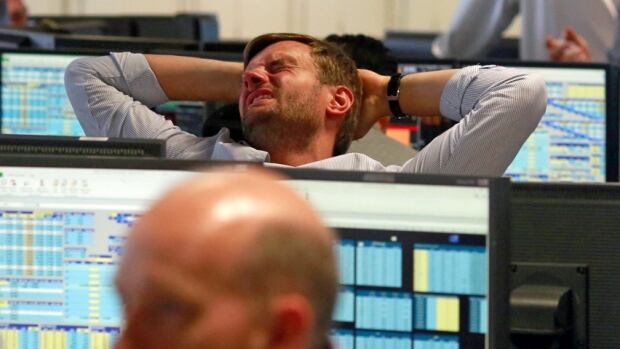
Most experts predicted Brexit would spell disaster for the U.K.'s economy. It hasn't happened. (REUTERS)
Rosenberg says markets are assuming we'll get all the good stuff Trump promised, including tax cuts for individuals and corporations as well as banking deregulation. But he says investors don't seem to be pricing in potential downsides.
"The markets shoot first and ask questions later, and this is just a classic case."
Scotiabank economist Derek Holt agrees that even if Trump delivers on the tax cuts, there's no guarantee that leads a straight line to a booming economy.
"It's not at all guaranteed that U.S. consumers will spend potential tax cuts after Trump takes office," Holt said. "This is not the Reagan era. Boomers are older now and ... they could well pocket the tax savings in preparation for retirement."
'Don't panic'
But what if a president Trump actually delivers on his promises? What if he somehow stems the flow of jobs and manufacturing out of the U.S.? What if he unleashes investment into small and new businesses across the country?
Steve Forbes, the chairman and editor in chief of Forbes Media, told CBC News that Trump may want to reform trade deals like NAFTA, but he isn't going to blow them up.
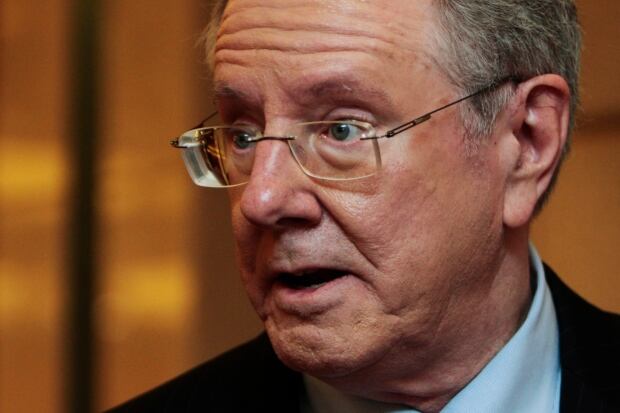
Steve Forbes, chairman and CEO of Forbes and editor in chief of Forbes Media, says his advice for investors is don't panic. (Tyrone Siu/Reuters)
The two-time candidate for the Republican presidential nomination has a simple piece of advice for investors on both sides of the Canada-U.S. border: Don't panic.
"I find it impossible to imagine that we're going to do what we did in 1930 and blow up the global trading system," Forbes said in an interview on Nov. 21. "There's too much at stake."
He says no one wants to pay $10,000 for an iPad, "which is the advantage of having global supply chains. So there'll be tweaks but not wholesale changes — so don't panic."
'We would be collateral damage'
But Jean Charest, former premier of Quebec and partner at Montreal law firm McCarthy Tétrault, says fears about NAFTA are at least partially justified.
"We have an American president taking a very direct shot across the bow in regards to NAFTA," he said. "He may not be targeting us, but we would be collateral damage."
But even Charest sees opportunity in the mist of unknowns. He says Canada can become a beacon for free trade in an age of U.S. protectionism. Many countries will be looking to make deals where they can and Canada will become increasingly attractive, he says, both as an investment hub and a place to make a counterpoint to protectionism in the U.S.
"That's an opportunity for us to present ourselves as a hub in North America, the door to Europe and also be the landing strip in North America for European investors."
Trade Minister Chrystia Freeland said as much in a speech Monday to announce a new federal agency to sell Canada as a great place for foreign investors to put their capital to work.
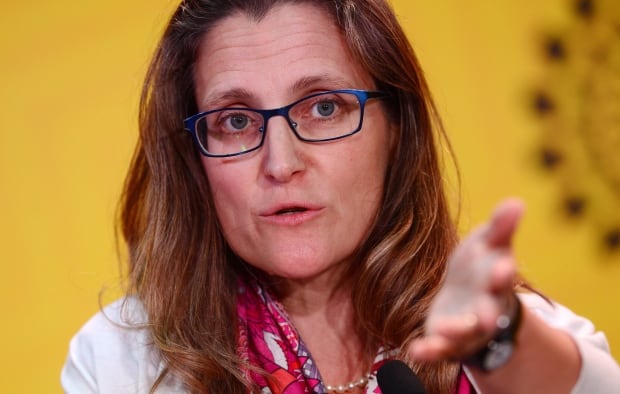
Trade Minister Chrystia Freeland says global trade is more important to Canada than ever before. (Sean Kilpatrick/Canadian Press)
Fear is an insidious thing. It seeps into everything and creeps past our defences. And if the economy isn't reacting the way we had expected it, how do we know what it will do next?
Especially when there's an unpredictable man headed to the White House to take the reins of the world's largest economy.
Journalists and experts alike spend most of their days trying to figure out what's new in any given situation. In some cases, it might be more useful to try to understand what hasn't changed. The fundamental issues facing Europe, the U.K. and the U.S. are still very much in place. Votes won't change that. Policies may, but policies are still a long way off. And markets will react when those policy decisions are made.
It's uncertain now. But what will it look like six months or a year from now? At this point, your guess is about as good as any so-called expert's.


